Follow us:

Green Hydrogen Solutions

The world needs more energy than ever before. It means that we need a sustainable system that can meet these growing demands, whilst also addressing CO2 emissions and the overall impact on the environment. One possible solution is hydrogen, which has the potential to deliver sustainable, efficient and affordable energy at scale.

Biomass gasification is a mature technology pathway that uses a controlled process involving heat, steam, and oxygen to convert biomass to hydrogen and other products, without combustion. Because growing biomass removes carbon dioxide from the atmosphere, the net carbon emissions of this method can be low, especially if coupled with carbon capture, utilization, and storage in the long term.

(1) One of the promising ways to produce green hydrogen is through biomass - a carbon neutral feedstock.

(2) Vivarta Greentech approach of green hydrogen generation goes beyond water thirsty electrolysis technology. Based on utilizing and building upon India’s surplus biomass capacity in an integrated manner leading to large scale local decarbonisation.

(3) India being a predominantly agriculture-based country, the availability of biomass from agricultural residue can be leveraged for producing hydrogen.

(4) At Vivarta we want to enhance capacity for our customers to handle our municipal solid waste through a commercially viable and scalable technology.

(5) Vivarta Greentech uses technology that can generate green hydrogen at a much competitive rate as we strive to nurture the industry and achieve a level playing field with other RE Tech.

(6) Our technology enables the farmers of our country to use their crop residue to generate clean green hydrogen for their own usage in a decentralized manner.

(7) Our mission is to attempt finding a sustainable solution to the agro waste burning issue leading to air pollution in major urban areas.

Problem:

The challenge that we face today is that despite the production of 75 million tonnes of hydrogen globally on an annual basis, 98% of it is produced using fossil fuels. This results in a significant amount of carbon emissions, amounting to over 800 million tonnes, which is even higher than the annual carbon emissions of Belgium. It is imperative that we find a solution to this problem and produce energy with fewer carbon emissions. This would not only help us reduce our carbon footprint but also help us achieve a more sustainable future.

Opportunity:

There is a great opportunity in front of us to tackle the problem of carbon emissions. This solution lies in green hydrogen, which is produced from biomass that is powered by clean and renewable electricity. This can play a crucial role in decarbonizing some of the world's hardest-to-abate sectors. The word "abundance" perfectly describes hydrogen, as it is the most abundant element in the universe. It is also widely used in various industries, including oil refining, ammonia and methanol production, and steel manufacturing. The global demand for hydrogen stands at 90 million tonnes annually, highlighting its importance as a source of energy. By utilizing green hydrogen, we can meet this demand in a more sustainable and environmentally-friendly manner.

Issues with existing technologies:

Despite hydrogen is being abundant and providing approximately 4% of the world's primary energy demand, with a market worth of $170 billion, the existing technology has its own set of problems. More than 90% of the demand for hydrogen stems from oil refining and ammonia production, with a shift towards green hydrogen in the steel industry imminent. Electrolysis is the most popular method of producing green hydrogen, but it currently only accounts for 0.1% of global hydrogen production. The process of electrolysis requires 60kW of electricity to break the stable molecule, and the best industrial electrodes currently use rare and precious metals such as iridium, ruthenium, and platinum, which are not common and have limited reserves. Iridium, in particular, is one of the rarest elements on Earth, with less than ten tonnes produced annually, and the geopolitical scenario raises concerns over the supply chain as Russia and China have control over major reserves of these rare earth metals.
Green hydrogen in India’s energy future:

India's energy future holds great potential, with a total energy demand of 800 million metric tonnes. The COP26 brought a renewed focus on decarbonization, with countries committing to phase down the use of fossil fuels and phase out inefficient fuel subsidies. As per the Green Hydrogen policy released in February 2022, India's total hydrogen demand is expected to reach 11.7 million metric tonnes by 2029-30, with a significant increase from the current 6.7 million metric tonnes. The policy mandates that fertilizer plants and oil refineries must use green hydrogen to meet 0.15% of their total hydrogen requirements starting 2023-24, ramping it up to 10% within six years.

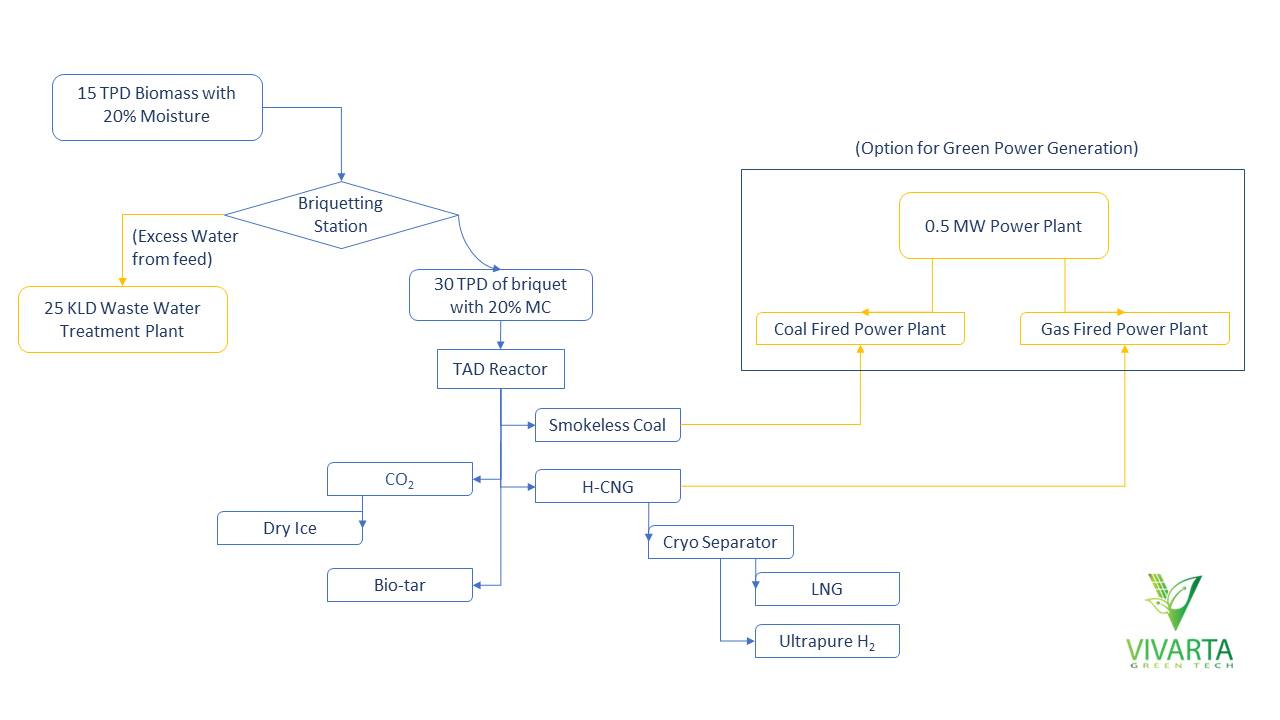
Ultrapure hydrogen can be captured which can be used as automative fuel.

Methane will be collected in liquid form as LNG and can be use as fuel.

Smokeless Bio-Coal generated in TAD process has GCV of ~6500 Kcal and can conduct electricity.

Tar can be used as corrosion protection paint

What is our solution?

The Thermally-accelerated Anaerobic Digestion (TAD) Technology is a revolutionary process that extracts Hydrogen (3-4%), Methane (12-14%) and bio-Tar (2-4%) by weight from bio-waste and converts it into smokeless bio-coal (25-28%). The fractionation process boasts an impressive 50% mass to fuel conversion efficiency, making it 5-7 times more efficient than any other biomass to fuel conversion processes in the world. The entire process can be powered by electricity generated from the byproducts generated during the process. TAD technology can use any biomaterial such as agricultural residue, fresh organic waste, dung, weed, etc as its raw material, which needs to be shaped if it is amorphous in nature. In the TAD reactors, raw materials are loaded and anaerobic conditions are created. Electrical heaters increase the internal temperature to start the conversion process, during which long carbon chains are broken down into smaller ones and gasses such as CO2, Ultrapure H2, CH4 (LNG) are collected. The final residue at the end of the process is coal with a GCV of more than 6600 Kcal/g, which is collected from the bottom.

Advantages

(1) Conversion Rate

It has highest mass to energy conversion rate compared to any other existing technology.

(2) Net Positive Energy

It produces its own energy and surplus energy is delivered.

(3) No Pollution

No exhaust gas is generated during this process. No liquid waste to contaminate water as well.

(4) Modular

It can be scaled up for larger projects also.

(5) Universal

The rector can handle different material in combination with same set up.

(6) By Products

Smokeless coal, ultra pure hydrogen, methane, bio-tar, CO2